TL;DR
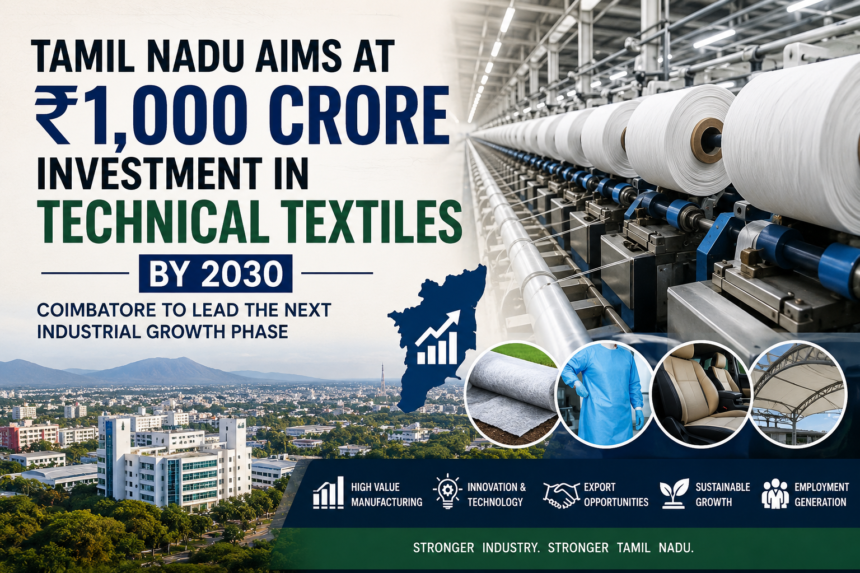
Tamil Nadu has set an ambitious target of attracting ₹1,000 crore in technical textiles investment by 2030, reinforcing its position as one of India’s leading textile manufacturing states. The initiative focuses on expanding high-value textile production, encouraging innovation, supporting sustainable manufacturing, and strengthening industrial ecosystems. Coimbatore, already recognized as the textile capital of South India, is expected to play a significant role in achieving this milestone through its strong manufacturing base, skilled workforce, and growing industrial infrastructure.
Tamil Nadu Targets ₹1,000 Crore Technical Textiles Investment by 2030: Coimbatore Emerges as a Key Growth Hub
Tamil Nadu Technical Textiles Investment is expected to witness a major boost over the coming years as the State has announced an ambitious goal of attracting ₹1,000 crore in investments by 2030. The initiative highlights Tamil Nadu’s long-term vision of strengthening its leadership in India’s textile sector while encouraging industries to adopt advanced manufacturing technologies and produce high-value technical textile products.
For Coimbatore, often referred to as the textile capital of South India, the announcement represents another opportunity to expand its industrial footprint. With decades of expertise in textile manufacturing, engineering excellence, and an extensive network of spinning mills, machinery manufacturers, and research institutions, the city is well-positioned to contribute significantly to the State’s vision.
Follow for more business news, Latest Coimbatore Industry News
What Are Technical Textiles?
Unlike conventional textiles used for clothing, technical textiles are specially engineered fabrics designed for performance, functionality, durability, and safety rather than appearance.
Today, technical textiles are widely used across industries including:
- Healthcare
- Agriculture
- Construction
- Automotive
- Defence
- Aerospace
- Sports
- Infrastructure
- Environmental protection
Products such as medical gowns, surgical masks, geotextiles used in road construction, industrial filters, fire-resistant fabrics, protective clothing, and automotive upholstery all fall under the technical textiles category.
As global demand continues to increase for specialized textile products, Tamil Nadu sees technical textiles as a major avenue for economic growth and industrial diversification.
Read to know kroe details about Ministry of Textiles, Government of India
Why Tamil Nadu Is Focusing on Technical Textiles
Tamil Nadu has long been India’s textile powerhouse, contributing significantly to yarn production, garment exports, knitwear, and spinning capacity. However, global markets are evolving rapidly, and demand is shifting toward value-added textile products with specialized industrial applications.
By focusing on Tamil Nadu Technical Textiles Investment, the State aims to:
Increase High-Value Manufacturing
Technical textiles generate higher value compared to conventional textile products, allowing manufacturers to improve profitability while competing in international markets.
Encourage Innovation
The sector requires advanced materials, research, and technology-driven manufacturing processes, encouraging industries to invest in innovation and product development.
Expand Export Opportunities
With increasing global demand for industrial textiles, Tamil Nadu hopes to strengthen its export potential by producing internationally competitive technical textile products.
Support Sustainable Growth
Many technical textile applications contribute to sustainability, including recyclable materials, water conservation technologies, and environmentally friendly industrial solutions.
Why Coimbatore Will Play a Crucial Role
When discussing Tamil Nadu Technical Textiles Investment, it is impossible to overlook Coimbatore’s importance.
The city has earned a strong reputation over several decades for its integrated textile ecosystem. From spinning mills and weaving units to textile machinery manufacturers and engineering companies, Coimbatore possesses one of India’s most comprehensive textile industry networks.
Several factors make Coimbatore an ideal destination for future technical textile investments:
Strong Manufacturing Base
Thousands of textile-related industries already operate across Coimbatore and nearby districts, providing a strong industrial foundation for advanced textile production.
Skilled Workforce
Engineering colleges, textile institutions, and vocational training centres continue to produce skilled professionals capable of supporting modern manufacturing requirements.
Machinery Manufacturing Expertise
Coimbatore is widely recognized for manufacturing textile machinery and engineering equipment, giving industries easier access to advanced production technologies.
Research and Innovation
Collaboration between industries, research institutions, and educational organizations has helped Coimbatore remain at the forefront of textile innovation for many years.
Manufacturing News in Coimbatore
Government’s Vision for 2030
The State’s investment target is not merely about attracting financial capital. It also reflects a broader industrial development strategy aimed at creating an ecosystem where businesses can innovate, expand, and compete globally.
The vision includes:
- Promoting advanced manufacturing
- Supporting MSMEs
- Encouraging startups in textile innovation
- Improving industrial infrastructure
- Strengthening research collaborations
- Enhancing export competitiveness
- Creating employment opportunities
Officials believe these efforts will enable Tamil Nadu to remain one of India’s leading textile destinations while adapting to changing global market demands.
Growing Global Demand Creates New Opportunities
Worldwide demand for technical textiles has been rising steadily across multiple industries.
Healthcare requires advanced medical textiles.
Infrastructure projects rely on geotextiles for roads and construction.
Automotive manufacturers increasingly use lightweight textile materials to improve efficiency.
Environmental sectors depend on filtration fabrics and pollution-control materials.
Agriculture benefits from protective fabrics, crop covers, irrigation textiles, and erosion control solutions.
As these industries continue expanding, Tamil Nadu hopes to position itself as a preferred manufacturing destination capable of serving both domestic and international markets.
Final Thoughts
The announcement of Tamil Nadu Technical Textiles Investment reaching a target of ₹1,000 crore by 2030 reflects the State’s commitment to strengthening its position as a leader in advanced textile manufacturing. By focusing on innovation, sustainability, research, and value-added production, Tamil Nadu aims to create a future-ready textile ecosystem capable of competing in global markets.
For Coimbatore, this initiative presents significant opportunities. With its well-established textile industry, engineering expertise, skilled workforce, and strong industrial infrastructure, the city is expected to play a pivotal role in attracting new investments and supporting the growth of the technical textiles sector. As industries increasingly adopt advanced manufacturing technologies, local businesses, startups, educational institutions, and professionals are likely to benefit from new avenues for collaboration and development.
The road to 2030 will require continued support from the government, industry stakeholders, and research institutions. If successfully implemented, the investment target could boost industrial growth, create employment opportunities, enhance exports, and reinforce Tamil Nadu’s reputation as one of India’s most dynamic textile manufacturing destinations.
As the technical textiles sector continues to evolve, Coimbatore is poised to remain at the heart of this transformation, contributing to both the State’s economic progress and India’s expanding presence in the global textile industry.
For More News Like This, Visit Today’s Coimbatore News Directory.
Lorem ipsum dolor sit amet, consectetur adipiscing elit. Ut elit tellus, luctus nec ullamcorper mattis, pulvinar dapibus leo.