TL;DR
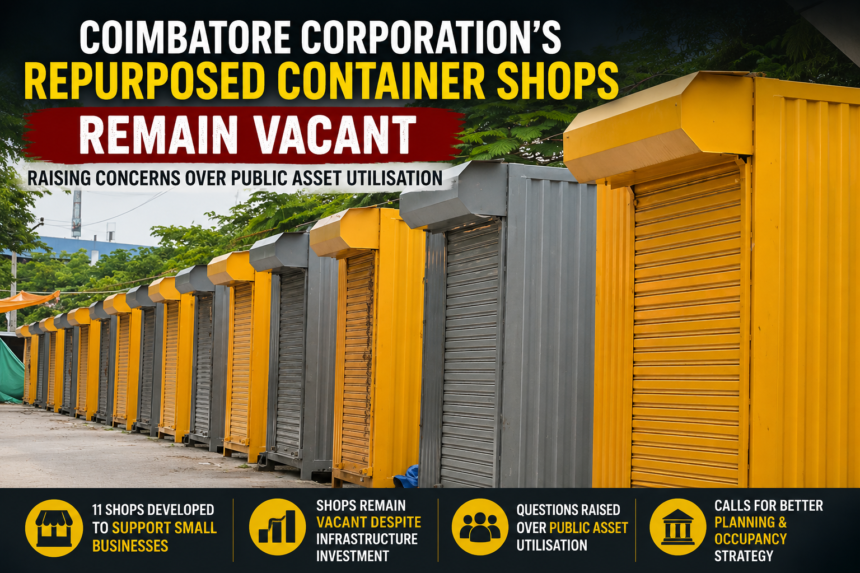
Repurposed container shops developed by the Coimbatore City Municipal Corporation (CCMC) continue to remain vacant despite being created as part of the city’s urban infrastructure initiatives. The unused commercial spaces have raised concerns regarding public asset utilisation, project planning, and the need to attract vendors to make the facilities operational.
Coimbatore Corporation’s Container Shops Yet to Find Occupants
The Coimbatore City Municipal Corporation (CCMC) is facing questions over a number of repurposed container shops that continue to remain vacant despite being developed to support small businesses and improve the city’s commercial infrastructure.
The container shops were introduced as an innovative solution to create affordable commercial spaces by converting shipping containers into retail outlets. However, many of these units have not yet been occupied, raising concerns over their utilisation and long-term sustainability.
The issue has sparked discussions on whether additional measures are required to make these spaces more attractive to prospective businesses.
Purpose Behind the Container Shop Project
The Corporation introduced the container shop initiative as part of its efforts to promote organised street vending and create affordable retail spaces within the city.
The objectives of the project include:
- Supporting small entrepreneurs.
- Providing organised commercial spaces.
- Improving the appearance of public areas.
- Encouraging local business growth.
- Better utilisation of public land.
- Creating sustainable urban infrastructure.
The project also aligns with broader urban development and Smart City objectives focused on improving public amenities.
Read to know more about the Coimbatore City Municipal Corporation
Why Are the Shops Still Vacant?
According to reports, several factors may have contributed to the shops remaining unoccupied, including:
- Limited interest from potential tenants.
- Location-related challenges.
- Commercial viability concerns.
- Rental affordability.
- Accessibility for customers.
- Market demand.
Officials are expected to continue exploring ways to improve occupancy and ensure that the infrastructure serves its intended purpose.
Impact of Vacant Public Infrastructure
When public infrastructure remains unused, it can affect:
- Return on public investment.
- Urban aesthetics.
- Economic activity.
- Opportunities for small businesses.
- Efficient use of civic resources.
- Public perception of development projects.
Experts often emphasize the importance of periodic reviews to assess the effectiveness of civic infrastructure projects after completion.
Read to know more about the Smart Cities Mission
Supporting Local Entrepreneurs
Affordable commercial spaces can play an important role in helping:
- Startups.
- Street vendors.
- Small retailers.
- Women entrepreneurs.
- Local artisans.
- Self-employed individuals.
If effectively utilised, container shops could contribute to employment generation and strengthen Coimbatore’s local economy.
Importance of Sustainable Urban Planning
Urban development projects are most successful when infrastructure is planned alongside long-term operational strategies.
Key considerations include:
- Suitable location selection.
- Market demand assessment.
- Affordable rental models.
- Public accessibility.
- Proper maintenance.
- Business-friendly policies.
Regular evaluation helps ensure that civic investments continue to benefit residents and local businesses.
Follow for more news updates Latest Coimbatore Infrastructure News
Challenges in Commercial Occupancy
While the concept of repurposed container shops has been widely adopted in several cities, long-term success depends on attracting businesses that can operate sustainably.
Some common challenges affecting occupancy include:
- Low customer footfall.
- Limited visibility from main roads.
- Rental affordability concerns.
- Competition from established commercial markets.
- Insufficient parking facilities.
- Lack of promotional support for new vendors.
Urban planners often stress that infrastructure projects should be supported by business-friendly policies to ensure their long-term viability.
How Vacant Commercial Spaces Affect the City
Unused commercial infrastructure can have wider implications beyond the vacant buildings themselves.
Potential impacts include:
- Reduced return on public investment.
- Missed employment opportunities.
- Lower economic activity.
- Underutilisation of civic assets.
- Increased maintenance costs.
- Reduced public confidence in infrastructure projects.
Ensuring effective utilisation of completed projects is considered an important aspect of sustainable urban governance.
Read to know more about the Ministry of Housing and Urban Affairs
Supporting Small Businesses Through Better Planning
Container shops have the potential to become affordable business hubs for entrepreneurs if supported with the right ecosystem.
Possible measures that could improve occupancy include:
- Affordable rental packages.
- Transparent allotment procedures.
- Better public accessibility.
- Directional signage and branding.
- Regular maintenance.
- Promotional events to attract customers.
- Dedicated parking facilities.
- Business support programmes for startups and local vendors.
Such initiatives could encourage more entrepreneurs to establish businesses in these spaces.
Adaptive Reuse: A Sustainable Urban Development Model
Repurposing shipping containers into commercial spaces is an example of adaptive reuse, a planning approach that converts existing materials into functional public infrastructure.
Adaptive reuse projects can offer several benefits:
- Reduced construction costs.
- Faster project implementation.
- Environmentally sustainable development.
- Efficient utilisation of available land.
- Modern and flexible commercial spaces.
- Lower construction waste.
When planned effectively, these projects can contribute to greener and more resilient urban development.
Coimbatore’s Growing Infrastructure Vision
Coimbatore continues to expand its civic infrastructure through initiatives focused on improving public amenities and supporting economic growth.
Recent development efforts include:
- Smart City projects.
- New parks and recreational spaces.
- Road and flyover improvements.
- Sewage treatment infrastructure.
- Lake restoration initiatives.
- Public transport enhancements.
- Commercial infrastructure development.
- Sustainable urban planning.
Ensuring that completed infrastructure is actively utilised remains an important part of achieving the city’s long-term development goals.
Frequently Asked Questions (FAQs)
1. What are the Coimbatore container shops?
They are repurposed shipping containers converted into commercial retail spaces by the Coimbatore City Municipal Corporation to support small businesses and organised vending.
2. Why are the container shops in the news?
Reports indicate that several of these shops remain vacant despite being developed, raising concerns about public asset utilisation and commercial occupancy.
3. What was the purpose of the project?
The project aimed to provide affordable retail spaces, support entrepreneurs, improve urban aesthetics, and encourage organised commercial activity.
4. Why is occupancy important?
Higher occupancy helps generate economic activity, supports small businesses, improves return on public investment, and ensures better utilisation of civic infrastructure.
5. What is adaptive reuse?
Adaptive reuse is the process of converting existing structures or materials—such as shipping containers—into functional spaces for new purposes, promoting sustainable urban development.
Conclusion
The continued vacancy of the Coimbatore Corporation’s repurposed container shops has renewed discussions about the importance of planning not only infrastructure creation but also its long-term utilisation. While the initiative reflects an innovative approach to supporting entrepreneurship and sustainable urban development, ensuring that these commercial spaces become operational is essential to maximise public investment.
As Coimbatore continues to grow through Smart City and civic infrastructure initiatives, periodic reviews, stakeholder engagement, and business-friendly strategies can help improve the effectiveness of similar projects in the future.
Today’s Coimbatore will continue to provide verified updates on civic administration, infrastructure, business, urban development, and public policy across Coimbatore and Tamil Nadu.
Lorem ipsum dolor sit amet, consectetur adipiscing elit. Ut elit tellus, luctus nec ullamcorper mattis, pulvinar dapibus leo.