TL;DR
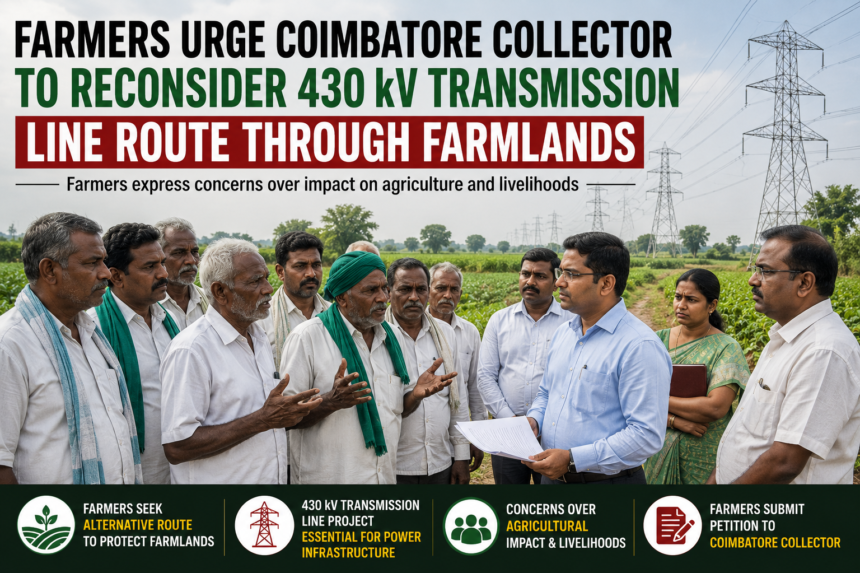
Farmers in Coimbatore have submitted a representation to the District Collector, requesting a reconsideration of the proposed 430 kV transmission line route passing through agricultural lands. They expressed concerns about the impact on farming activities, crop cultivation, and livelihoods, while urging authorities to explore alternative alignments that minimize disruption to productive farmland.
Farmers Appeal for Change in 430 kV Transmission Line Route
A group of farmers from Coimbatore has appealed to the District Collector to reconsider the proposed alignment of a 430 kV power transmission line, stating that the current route passes through fertile agricultural lands and could significantly affect farming activities.
The representation was submitted during the public grievance meeting, where farmers requested the administration to examine alternative routes that would reduce the impact on cultivable land while allowing the infrastructure project to proceed.
The issue highlights the ongoing challenge of balancing infrastructure development with the protection of agricultural resources.
Concerns Raised by Farmers
According to the representation submitted to the Collector, farmers expressed several concerns regarding the proposed transmission line alignment.
These include:
- Loss of cultivable agricultural land.
- Possible reduction in agricultural productivity.
- Impact on long-term farming operations.
- Restrictions on future land use.
- Financial implications for farmers.
- Preservation of fertile farmland.
The farmers requested that officials conduct a fresh review of the route and consider alternatives wherever feasible.
Importance of the 430 kV Transmission Line Project
High-voltage transmission lines play a vital role in strengthening the electricity network by improving power transmission capacity and supporting growing energy demand.
Such projects generally help:
- Improve power reliability.
- Strengthen the State’s electricity grid.
- Support industrial and urban growth.
- Facilitate long-distance power transmission.
- Enhance energy infrastructure.
While these projects are essential for development, authorities often seek to balance infrastructure expansion with environmental and social considerations.
Balancing Development and Agriculture
Infrastructure projects passing through rural areas frequently require careful planning to minimize their impact on agriculture and local communities.
Experts suggest that project planning should focus on:
- Protecting productive farmland.
- Conducting detailed environmental assessments.
- Engaging with affected landowners.
- Evaluating technically feasible alternative routes.
- Providing transparent communication throughout the planning process.
Such measures can help reduce conflicts while supporting long-term development objectives.
Role of the District Administration
The Coimbatore District Administration receives public representations on various civic and development issues during regular grievance meetings.
After receiving such petitions, authorities may:
- Review the concerns raised.
- Seek technical reports from relevant departments.
- Coordinate with the power transmission agency.
- Examine applicable rules and project requirements.
- Communicate any decisions or further actions through the appropriate administrative process.
At the time of reporting, the farmers’ request forms part of the ongoing administrative consideration process.
Follow for know more about the Environmental news in Coimbatore
Why This Issue Matters
The discussion surrounding the proposed transmission line reflects a broader challenge faced across India – meeting increasing energy demands while protecting agricultural land and rural livelihoods.
Achieving this balance requires:
- Sustainable infrastructure planning.
- Transparent public consultation.
- Scientific route selection.
- Fair consideration of stakeholder concerns.
- Environmentally responsible development.
Constructive dialogue between farmers and authorities remains an important part of this process.
Follow for more instant updates in Latest Agriculture & Infrastructure News from Today’s Coimbatore
Need for a Balanced Approach to Infrastructure Development
Large-scale power transmission projects are essential for meeting the growing electricity demands of residential, commercial, industrial, and agricultural sectors. However, projects that pass through productive agricultural land often require careful planning to minimise their impact on farmers and rural communities.
Experts suggest that successful infrastructure planning should focus on:
- Protecting fertile agricultural land wherever possible.
- Conducting transparent route assessments.
- Engaging with affected landowners before implementation.
- Exploring technically feasible alternative alignments.
- Ensuring compliance with environmental and land-use regulations.
- Balancing development with the interests of local communities.
A collaborative approach can help achieve both infrastructure expansion and agricultural sustainability.
Why Farmers Are Concerned
For many farming families, agricultural land is not only their primary source of income but also a long-term investment passed down through generations.
According to the farmers’ representation, the proposed transmission line alignment could lead to concerns such as:
- Restrictions on agricultural operations.
- Reduced flexibility in future land development.
- Possible decline in land value.
- Challenges in cultivating certain crops.
- Long-term uncertainty regarding farming activities.
The farmers have therefore appealed to the authorities to review the alignment and consider alternatives that reduce the impact on productive farmland.
Read to know more about the Tamil Nadu Transmission Corporation (TANTRANSCO)
Importance of Reliable Power Infrastructure
High-voltage transmission lines form a critical part of Tamil Nadu’s electricity network, enabling power to be transmitted efficiently across districts.
Benefits of modern transmission infrastructure include:
- Improved power reliability.
- Support for industrial development.
- Stable electricity supply for homes and businesses.
- Better integration of renewable energy sources.
- Reduced transmission losses.
- Strengthened energy security for future demand.
While these benefits are significant, infrastructure planning often seeks to minimise disruption to local communities and agricultural ecosystems.
Role of Public Consultation
Public consultation plays an important role in major infrastructure projects. It provides an opportunity for residents, farmers, and stakeholders to express their concerns and contribute to the planning process.
Through representations submitted to the district administration, affected communities can:
- Highlight local issues.
- Request route modifications.
- Seek clarification on project implementation.
- Suggest alternative solutions.
- Ensure their concerns are considered before final decisions are made.
Such engagement helps improve transparency and public confidence in development projects.
Possible Administrative Process
Following the submission of the petition, the concerned authorities may undertake several steps as part of the administrative review process, including:
- Examining the farmers’ representation.
- Reviewing technical feasibility reports.
- Consulting the transmission agency.
- Assessing environmental and agricultural impacts.
- Evaluating alternative route options, where practical.
- Communicating any decisions through the appropriate government channels.
The final decision will depend on technical, legal, environmental, and administrative considerations.
Read to know more about the Power Grid Corporation of India
Frequently Asked Questions (FAQs)
1. Why have farmers approached the Coimbatore Collector?
They have requested a review of the proposed 430 kV transmission line alignment, stating that it passes through productive agricultural land.
2. What is the purpose of the 430 kV transmission line?
The project is intended to strengthen Tamil Nadu’s electricity transmission network and improve the reliability of power supply.
3. What are the farmers requesting?
They have urged authorities to examine alternative routes that reduce the impact on agricultural land while allowing the project to proceed.
4. Has the route been officially changed?
As of now, no official decision has been announced. The matter is under administrative consideration following the farmers’ representation.
5. Why is public consultation important in infrastructure projects?
Public consultation allows affected communities to raise concerns, suggest alternatives, and contribute to transparent and informed decision-making.
Conclusion
The request submitted by farmers to reconsider the 430 kV transmission line route reflects the ongoing challenge of balancing essential infrastructure development with the protection of agricultural land and rural livelihoods. As Tamil Nadu continues to strengthen its power transmission network, careful planning and meaningful public engagement remain vital to ensuring sustainable and inclusive development.
The outcome of the administrative review will be closely watched by farmers, local residents, and stakeholders, as it may influence both the progress of the project and the preservation of valuable agricultural resources.
Today’s Coimbatore will continue to provide verified updates on infrastructure, agriculture, governance, and major developments across Coimbatore and Tamil Nadu.
Lorem ipsum dolor sit amet, consectetur adipiscing elit. Ut elit tellus, luctus nec ullamcorper mattis, pulvinar dapibus leo.