TL;DR
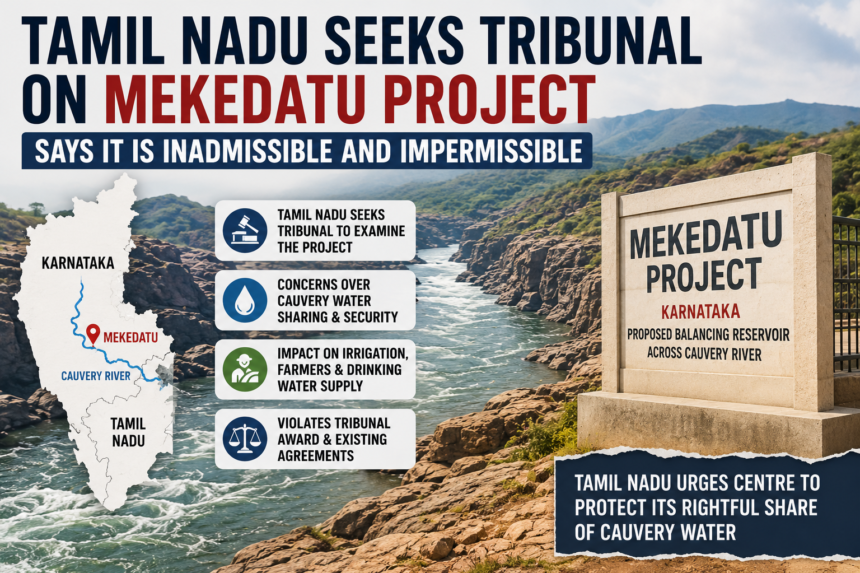
The Tamil Nadu Mekedatu Project issue has once again come into focus after the State urged the Union Government to constitute a tribunal to examine Karnataka’s proposed Mekedatu project. Tamil Nadu argues that the project is “inadmissible and impermissible” as it could impact its rightful share of Cauvery water, affect irrigation, and threaten drinking water security for millions of people dependent on the river. The State has reiterated that any project on the Cauvery basin must comply with the Cauvery Water Disputes Tribunal award and existing legal frameworks.
Tamil Nadu Mekedatu Project Row Intensifies as State Seeks Tribunal
The Tamil Nadu Mekedatu Project debate has resurfaced with renewed intensity after Tamil Nadu formally sought the constitution of a tribunal to examine Karnataka’s proposed reservoir project at Mekedatu.
Water remains one of the most critical resources for agriculture, drinking water supply, and economic development across South India. As a result, any development affecting the Cauvery River attracts significant public and political attention.
Tamil Nadu maintains that the proposed project could adversely affect downstream water availability and therefore requires detailed legal and technical scrutiny before any approval process moves forward.
Follwo for More updates, Latest Tamil Nadu News
What Is the Mekedatu Project?
The Mekedatu Project is a proposed balancing reservoir planned by Karnataka across the Cauvery River near Kanakapura.
According to Karnataka, the project aims to:
- Store water for drinking purposes
- Improve water management
- Meet future urban water requirements
- Support regional development
However, Tamil Nadu argues that any new reservoir on the Cauvery must be evaluated carefully due to its potential impact on downstream states.
The Tamil Nadu Mekedatu Project issue therefore extends beyond infrastructure development and enters the larger framework of interstate water sharing.
To read for more information Cauvery Water Management Authority
Why Tamil Nadu Opposes the Mekedatu Project
Tamil Nadu has consistently raised objections to the project for several reasons.
Concerns Over Water Availability
The State argues that storing additional water upstream could influence the flow reaching Tamil Nadu.
For regions dependent on Cauvery water, maintaining assured water flow remains critical.
Protection of Farmers’ Interests
Agriculture in many districts relies heavily on Cauvery irrigation.
Farmers fear that any reduction in water availability may affect cultivation and crop productivity.
Drinking Water Security
Millions of residents depend on Cauvery water for drinking purposes.
Tamil Nadu believes water security must remain a priority while evaluating any upstream project.
Compliance With Existing Awards
Tamil Nadu has emphasized that all decisions must align with the Cauvery Water Disputes Tribunal Award and the Supreme Court’s directions.
The Tamil Nadu Mekedatu Project discussion therefore revolves around legal, environmental, and social considerations.
Importance of the Cauvery River for Tamil Nadu
The Cauvery River serves as a lifeline for several districts.
Its importance includes:
Irrigation
Large agricultural areas depend on Cauvery waters.
Drinking Water Supply
Urban and rural populations rely on the river.
Economic Activity
Agriculture and allied industries benefit from dependable water availability.
Rural Livelihoods
Thousands of farming families depend on river-based irrigation systems.
Any discussion regarding the Tamil Nadu Mekedatu Project inevitably involves these broader concerns.
Read to know more about the Water Resources News
Understanding the Cauvery Water Dispute
The Cauvery water dispute is one of India’s longest-running interstate river disputes.
The issue primarily involves:
- Tamil Nadu
- Karnataka
- Kerala
- Puducherry
Over the years, various legal and administrative mechanisms have been established to regulate water sharing.
These include:
- Cauvery Water Disputes Tribunal
- Supreme Court Judgments
- Cauvery Water Management Authority (CWMA)
Tamil Nadu believes the Mekedatu proposal must be examined within this established framework.
Why Tamil Nadu Wants a Tribunal
Tamil Nadu has requested the formation of a tribunal to ensure:
Independent Evaluation
A tribunal can assess the proposal objectively.
Legal Compliance
Existing awards and judgments must be respected.
Protection of State Interests
Water rights and allocations need safeguarding.
Scientific Assessment
Environmental and hydrological impacts require detailed examination.
The demand highlights the seriousness with which Tamil Nadu views the Tamil Nadu Mekedatu Project issue.
Read to know more abbout the Ministry of Jal Shakti
Potential Impact on Agriculture
Agriculture remains one of the sectors most sensitive to water availability.
Possible concerns include:
- Reduced irrigation reliability
- Crop planning uncertainty
- Water allocation challenges
- Economic effects on farming communities
Tamil Nadu’s agricultural stakeholders have repeatedly emphasized the importance of preserving assured Cauvery water flows.
Drinking Water Concerns
Apart from agriculture, drinking water security forms a major aspect of the debate.
Urban centers and rural communities depend on consistent water supply systems connected directly or indirectly to the Cauvery basin.
The Tamil Nadu Mekedatu Project discussion therefore involves both present and future water needs.
Environmental Considerations
Environmental experts often highlight the need for careful assessment of large water infrastructure projects.
Key considerations include:
River Ecosystems
Natural flow patterns support biodiversity.
Watershed Management
Sustainable management of river basins is essential.
Climate Variability
Future rainfall patterns may affect water availability.
Long-Term Sustainability
Development projects must balance growth with ecological protection.
Read to know more about the Central Water Commission
Political and Public Reactions
The issue continues to generate debate among policymakers, experts, farmers, and the public.
Many stakeholders believe that transparent discussions and scientific evaluation are essential before major decisions are taken.
Public interest remains high because the Cauvery directly affects the lives and livelihoods of millions of people.
What Happens Next?
The future course of the Tamil Nadu Mekedatu Project issue will depend on legal, administrative, and policy developments.
Possible next steps include:
- Review by relevant authorities
- Further consultations
- Legal examination
- Technical assessments
- Discussions between stakeholder states
Observers expect continued attention on the matter due to its importance for water management and interstate relations.
Follow for more updates Tamil Nadu Development News
Why This Matters Beyond Tamil Nadu
The Mekedatu debate reflects broader questions facing many regions in India:
- Water security
- Interstate cooperation
- Sustainable resource management
- Climate resilience
- Agricultural sustainability
How these issues are addressed could influence future approaches to river basin management across the country.
Final Thoughts
The Tamil Nadu Mekedatu Project issue remains one of the most significant water-related discussions in South India. Tamil Nadu’s demand for a tribunal reflects concerns over water security, agricultural sustainability, and adherence to established legal frameworks governing the Cauvery River.
As discussions continue, the focus is likely to remain on balancing development objectives with equitable water sharing and long-term environmental sustainability. For millions dependent on the Cauvery, the outcome will carry importance far beyond policy debates, influencing livelihoods, agriculture, and water availability for years to come.
For More news like this, visit Todays Coimbatore News Directory.