TL;DR
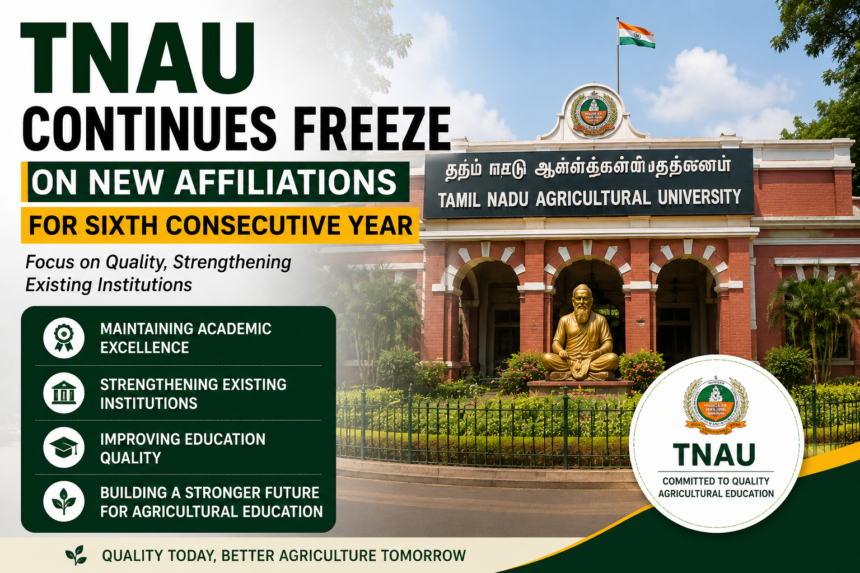
The TNAU New Affiliations Freeze has been extended for the sixth consecutive year, with Tamil Nadu Agricultural University continuing its policy of not affiliating new agricultural institutions. The university has emphasized maintaining educational quality, strengthening existing institutions, improving infrastructure, and ensuring better academic outcomes for students. The move highlights TNAU’s focus on sustainable growth in agricultural education rather than rapid expansion.
TNAU Continues Freeze on New Agricultural College Affiliations
The TNAU New Affiliations Freeze remains in place as Tamil Nadu Agricultural University (TNAU) has decided not to affiliate new agricultural institutions for the sixth consecutive year.
The decision reflects the university’s continued emphasis on maintaining educational standards and ensuring that existing colleges receive adequate academic support, infrastructure development, and quality monitoring.
As one of India’s leading agricultural universities, TNAU plays a critical role in shaping agricultural education, research, and innovation. Any policy decision made by the university has significant implications for students, educational institutions, and the agricultural sector across Tamil Nadu.
The continuation of the TNAU New Affiliations Freeze has generated discussions among educators, students, and policymakers about the future direction of agricultural education in the state.
Follow for more updates Latest Education News in Coimbatore
Why TNAU Has Extended the Affiliations Freeze
According to university officials, the primary objective behind the decision is to maintain academic excellence and strengthen existing institutions.
Over the years, TNAU has focused on:
- Improving teaching quality
- Enhancing research capabilities
- Strengthening laboratory facilities
- Upgrading infrastructure
- Improving student outcomes
- Expanding industry collaboration
Rather than increasing the number of affiliated colleges, the university is prioritizing improvements within the existing ecosystem.
The TNAU New Affiliations Freeze is therefore viewed as a quality-focused strategy rather than a restriction on educational growth.
Understanding TNAU’s Role in Agricultural Education
Tamil Nadu Agricultural University is among India’s most respected agricultural institutions.
The university contributes significantly to:
Agricultural Research
Developing innovative farming technologies and crop varieties.
Student Education
Training future agricultural professionals and scientists.
Extension Services
Supporting farmers with practical knowledge and field-level solutions.
Rural Development
Promoting sustainable agricultural practices.
Because of this influence, decisions regarding affiliations have a statewide impact.
Read to know ore details for this Official TNAU Website
Quality Over Quantity: The University’s Approach
Educational institutions often face a choice between expansion and quality enhancement.
TNAU appears to be prioritizing:
Better Faculty Standards
Ensuring qualified faculty members are available across affiliated institutions.
Strong Infrastructure
Providing adequate laboratories, farms, libraries, and research facilities.
Improved Academic Monitoring
Maintaining consistency in curriculum delivery and student evaluation.
Research Excellence
Encouraging innovation and practical learning opportunities.
The TNAU New Affiliations Freeze aligns with these objectives.
Impact on Agricultural Colleges in Tamil Nadu
Existing affiliated colleges are likely to benefit from greater institutional focus.
Potential advantages include:
- Improved academic supervision
- Better allocation of resources
- Enhanced curriculum implementation
- Increased research opportunities
- Stronger student support systems
Many education experts believe that strengthening current institutions can produce better long-term outcomes than rapid expansion.
What This Means for Students
Students planning to pursue agricultural education may wonder how the decision affects them.
The continuation of the TNAU New Affiliations Freeze does not impact admissions to existing institutions.
Students can continue to apply for:
- Undergraduate agriculture courses
- Horticulture programs
- Agricultural engineering programs
- Agribusiness studies
- Postgraduate agricultural education
Existing colleges remain fully operational and continue to offer approved academic programs.
Follow for more Higher Education News in Tamil Nadu
Growing Demand for Agricultural Education
Agriculture is increasingly becoming a technology-driven sector.
Modern agriculture now involves:
Precision Farming
Use of technology for efficient crop management.
Agri-Tech Innovation
Application of digital solutions in farming.
Sustainable Agriculture
Environmentally responsible cultivation methods.
Food Security Research
Improving crop productivity and resilience.
As demand for agricultural professionals increases, maintaining educational quality becomes even more important.
The TNAU New Affiliations Freeze reflects the university’s commitment to producing highly skilled graduates.
Challenges in Expanding Agricultural Education
While expansion can improve access, it also presents challenges.
These include:
Faculty Availability
Recruiting experienced agricultural educators can be difficult.
Infrastructure Requirements
Agricultural colleges require extensive practical learning facilities.
Research Resources
Quality research requires significant investment.
Regulatory Compliance
Maintaining standards across multiple institutions can be complex.
The university appears to believe that strengthening existing institutions is currently the most effective strategy.
Coimbatore’s Importance in Agricultural Education
Coimbatore has long been recognized as a major educational and research hub.
TNAU’s headquarters in the city has helped establish Coimbatore as a center for:
- Agricultural innovation
- Scientific research
- Higher education
- Farm technology development
The TNAU New Affiliations Freeze therefore has particular significance for Coimbatore, which remains closely connected to agricultural education policy in Tamil Nadu.
How Agricultural Education Is Evolving
The future of agricultural education is changing rapidly.
Emerging areas include:
Artificial Intelligence in Agriculture
Data-driven farming practices.
Climate-Smart Agriculture
Adapting farming methods to climate challenges.
Water Management
Efficient irrigation and resource utilization.
Agricultural Entrepreneurship
Creating new business opportunities in the agricultural sector.
TNAU’s focus on strengthening existing institutions may help ensure students receive training aligned with these evolving requirements.
ICAR Agricultural Education Resources
Educational Standards Remain a Priority
Universities across India are increasingly focusing on outcome-based education.
Key priorities include:
- Employability
- Practical skills
- Industry readiness
- Research competency
- Innovation capacity
The continuation of the TNAU New Affiliations Freeze suggests that academic quality remains a central priority for the university.
Future Possibilities
While no new affiliations are currently being approved, future decisions may depend on:
- Infrastructure readiness
- Faculty availability
- Academic demand
- Policy changes
- Resource allocation
Educational experts believe the university will continue evaluating the sector’s needs before making future expansion decisions.
Follow for Coimbatore Education Updates
Why This Decision Matters
The significance of the TNAU New Affiliations Freeze extends beyond administrative policy.
It reflects broader discussions about:
- Educational quality
- Sustainable institutional growth
- Agricultural workforce development
- Research excellence
- Long-term academic planning
As agriculture continues to evolve, the quality of education provided to future professionals becomes increasingly important.
Final Thoughts
The continuation of the TNAU New Affiliations Freeze for the sixth consecutive year demonstrates Tamil Nadu Agricultural University’s commitment to maintaining educational excellence. By focusing on strengthening existing institutions, improving academic standards, and supporting research-driven learning, the university aims to build a stronger foundation for agricultural education.
As students, educators, and policymakers look toward the future, the decision highlights an important principle: sustainable educational growth depends not only on expansion but also on ensuring that quality remains at the center of every academic initiative.
For More news like this, visit Todays Coimbatore News Directory.