TL;DR
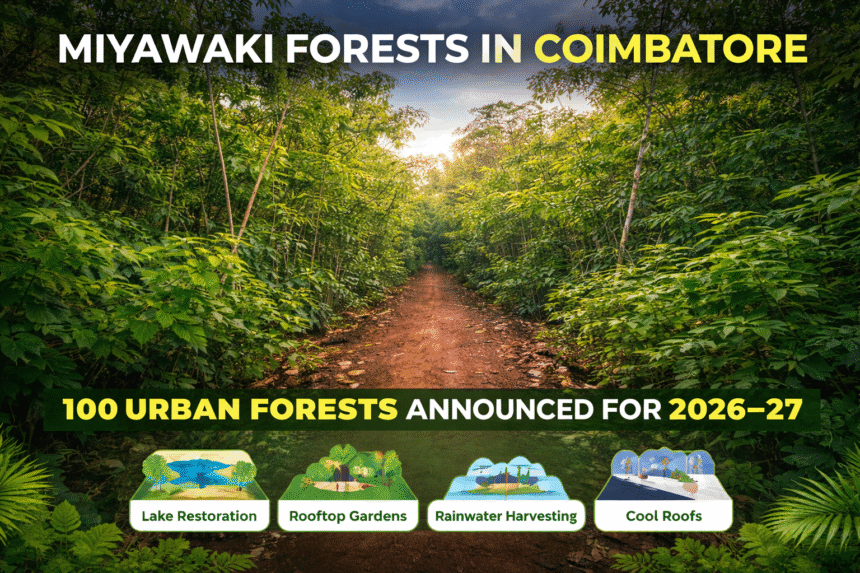
Coimbatore’s Climate Budget 2026–27 proposes the creation of 100 Miyawaki forests across parks and urban spaces to boost green cover and biodiversity. The plan also includes lake restoration, open well renovation, rooftop gardens, rainwater harvesting, and Cool Roof measures to address heat and climate challenges. This marks a major step toward sustainable urban development in the city.
Miyawaki Forests in Coimbatore: A Bold Climate Move for a Greener Future
The announcement of Miyawaki Forests in Coimbatore under the Coimbatore Climate Budget 2026–27 is more than just a plantation drive. It is a structured environmental strategy aimed at strengthening the city’s green cover, restoring ecological balance, and preparing Coimbatore for rising climate challenges. The proposal includes the development of 100 Miyawaki forests in parks and major urban locations, making it one of the most ambitious urban greening projects in the region.
Urban expansion has steadily reduced tree density in many parts of the city. With increasing temperatures and declining biodiversity, the need for structured urban forest development has become urgent. The Miyawaki method offers a scientific and high-density plantation technique that allows forests to grow 10 times faster and become 30 times denser than conventional plantations.
Authority Source on Miyawaki Method
What Are Miyawaki Forests and Why Coimbatore Needs Them
The Miyawaki method, developed by Japanese botanist Akira Miyawaki, focuses on planting native species closely together to mimic natural forest ecosystems. These forests require minimal maintenance after the initial growth period and create a self-sustaining ecosystem.
For Coimbatore, which experiences intense summer heat and increasing urbanization, Miyawaki Forests in Coimbatore could significantly improve air quality, reduce surface temperature, and increase groundwater recharge. Urban forests help absorb carbon dioxide, trap dust particles, and reduce the urban heat island effect.
In addition to environmental benefits, these forests create micro-habitats for birds, insects, and small wildlife, directly supporting Coimbatore biodiversity projects.
Environmental Research Authority
Coimbatore Climate Budget 2026–27: A Multi-Dimensional Green Strategy
The Coimbatore Climate Budget 2026-27 does not stop with Miyawaki forests. The plan integrates multiple sustainability measures to create long-term impact:
1. Lake Restoration in Coimbatore
Water bodies in and around the city have faced encroachment and pollution over the years. The budget includes structured lake restoration projects aimed at improving water storage capacity and ecosystem health.
Healthy lakes contribute to flood prevention, groundwater recharge, and temperature regulation. Reviving water bodies strengthens the overall environmental resilience of the city.
Government Environmental Portal
2. Renovation of 836 Open Wells
Open wells are traditional water sources that once played a vital role in Tamil Nadu’s water management system. Renovating 836 open wells is not just restoration – it’s reviving heritage-based sustainability. This initiative aligns with rainwater harvesting efforts and groundwater recharge strategies.
3. Rooftop Gardens in Coimbatore
Rooftop gardens are gaining popularity in urban sustainability planning. Encouraging rooftop gardens in Coimbatore will:
- Reduce indoor temperatures
- Improve air quality
- Promote local food cultivation
- Enhance urban aesthetics
This step complements Miyawaki Forests in Coimbatore by expanding green spaces vertically.
Related Article on Urban Gardening in Coimbatore
4. Rainwater Harvesting in Coimbatore
Rainwater harvesting systems are critical in a city that depends heavily on monsoon cycles. The climate budget emphasizes strengthening rainwater harvesting infrastructure to reduce water scarcity and dependence on external water sources.
5. Cool Roof Measures
The Cool Roof initiative involves reflective roofing materials that reduce heat absorption. This is especially impactful in densely built areas where heat retention increases energy consumption.
Combined with Miyawaki Forests in Coimbatore, Cool Roof measures can significantly reduce ambient temperature and improve living conditions.
Climate Adaptation Research Institute
How Miyawaki Forests in Coimbatore Will Improve Urban Living
The real impact of Miyawaki Forests in Coimbatore goes beyond greenery. Here’s how it transforms daily life:
Improved Air Quality
Dense plantations absorb pollutants and fine dust particles, leading to measurable improvements in air quality.
Reduced Urban Heat
Green cover lowers ground temperature and reduces heat reflection from concrete surfaces.
Increased Biodiversity
Native plants attract birds, butterflies, and pollinators, strengthening ecological networks.
Community Engagement
Urban forests can become community spaces for education, awareness, and environmental volunteering.
Coimbatore Environmental Initiatives Regarding News Updates
Environmental Sustainability in Coimbatore: A Long-Term Vision
Urban development and environmental conservation often seem like opposing forces. However, the structured integration of Miyawaki Forests in Coimbatore into city planning shows a shift toward sustainable urban governance.
Instead of isolated plantation drives, this approach connects biodiversity projects, water conservation, and climate adaptation strategies into one comprehensive model. It reflects a broader movement in Tamil Nadu toward environmentally responsible urbanization.
Economic and Social Impact of Urban Forest Development
Green initiatives are not just environmental decisions; they have economic value:
- Increased property value near green spaces
- Reduced healthcare costs due to improved air quality
- Enhanced tourism potential
- Job creation in nursery management and landscaping
Urban greening projects in Coimbatore also contribute to better mental health outcomes by creating accessible natural spaces within city limits.
Challenges and Implementation Considerations
While the proposal for Miyawaki Forests in Coimbatore is promising, implementation will determine success. Key considerations include:
- Selection of truly native plant species
- Long-term monitoring and maintenance
- Public awareness and participation
- Protection from encroachment
Transparency in execution and regular progress updates will be crucial to ensure measurable outcomes.
Why This Matters Now
Climate change is no longer a distant concern. Rising temperatures, unpredictable rainfall, and water stress are visible realities. The Climate Budget 2026 – 27 signals proactive governance.
If executed effectively, Miyawaki Forests in Coimbatore could become a benchmark for other cities in Tamil Nadu and across India.
Urban forests are not decorative additions. They are infrastructure. Green infrastructure.
The Bigger Picture: A Greener Coimbatore
When lake restoration, rainwater harvesting, rooftop gardens, Cool Roof initiatives, and Miyawaki forests work together, the result is a resilient urban ecosystem.
The proposal under the Coimbatore Climate Budget 2026 – 27 positions the city as a progressive example of climate-conscious planning. The focus on biodiversity, green cover expansion, and traditional water systems indicates a blend of science and heritage.
The success of Miyawaki Forests in Coimbatore will depend not only on policy execution but also on citizen participation.
Conclusion
The announcement of Miyawaki Forests in Coimbatore marks a defining moment in the city’s environmental roadmap. With 100 urban forests planned alongside lake restoration, open well renovation, rooftop gardens, rainwater harvesting, and Cool Roof measures, the Climate Budget 2026–27 outlines a comprehensive sustainability framework.
If implemented with consistency and transparency, this initiative can reshape Coimbatore’s ecological future-making it cooler, cleaner, and greener for generations to come.
For More news like this, visit Todays Coimbatore News Directory