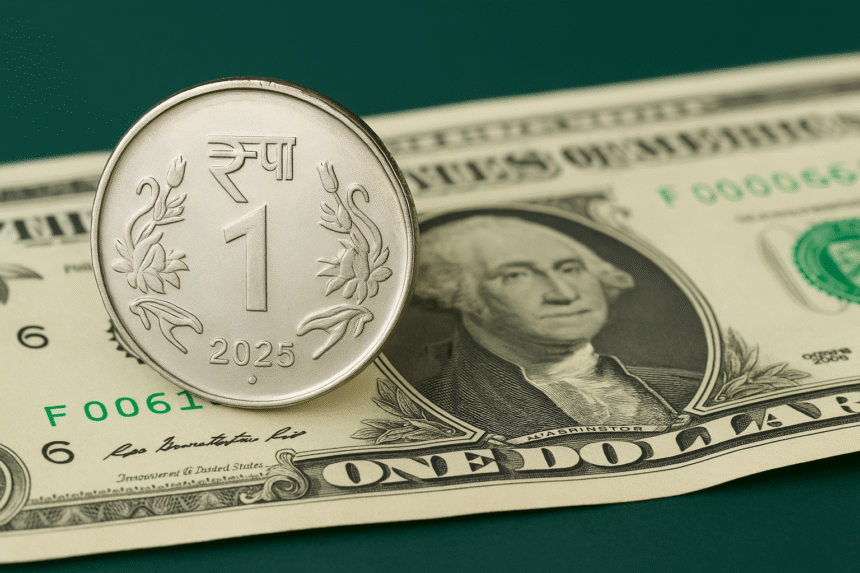
Indian Rupee Sees Sharp Correction Against US Dollar as Demand Surges in Global Markets
TL;DR
The Indian Rupee experienced a sharp correction against the US Dollar due to a sudden surge in global dollar demand. The exchange rate adjusted by 39 paise, settling around ₹89.92 as international market pressures, oil prices, and institutional inflows influenced daily currency movement. Economists suggest this is part of a larger cycle driven by global uncertainty and rising US yields.
Introduction
The global currency market witnessed a significant shift today, with the Indian Rupee undergoing a sharp correction against the US Dollar. According to early Wednesday’s trading data, the Rupee weakened by 39 paise, settling at approximately ₹89.92, driven mainly by a sudden spike in dollar demand across international markets. While currency value fluctuations are part of routine market behavior, the intensity and timing of today’s correction have drawn increased attention from traders, analysts, and investors across India and overseas.
Currency markets are often influenced by macroeconomic pressures, shifts in global sentiment, and geopolitical developments. The Indian Rupee, being one of the most actively traded Asian currencies, frequently responds to external triggers. Today’s correction is no exception.
What Triggered the Rupee’s Decline Today?
Reports indicate a surge in demand for the US Dollar, following multiple global economic factors. Among the most relevant:
1. Rising US Treasury Yields
Whenever US yields climb, global investors often move capital back into the American market, strengthening the dollar. This shift increases demand for the currency, causing emerging market currencies like the Indian Rupee to face downward pressure.
To understand similar trends, you can explore references available on Investopedia for deeper financial insights.
2. Increasing Crude Oil Prices
India is one of the world’s largest importers of crude oil. When oil prices rise globally, India must spend more US dollars for imports. This increases dollar demand and naturally weakens the Rupee.
According to global energy trackers such as Bloomberg and Reuters, crude prices have seen consistent upward momentum this week due to supply constraints.
3. Heavy Foreign Capital Outflow
Institutional investors, especially FIIs (Foreign Institutional Investors), appear to be shifting their portfolios away from emerging markets and toward safer assets. This movement usually results in foreign exchange outflows, further weakening local currencies.
Rupee’s Performance in the Recent Months
The Indian Rupee has been relatively stable for much of the year. Analysts say that despite periodic fluctuations, it has demonstrated resilience and managed to avoid sharp volatility compared to other Asian currencies.
However, the past few days have seen an increase in intraday movement, largely due to global market uncertainties, geopolitical tensions, and fresh signals from the US Federal Reserve. According to financial experts, these rapid changes are a reflection of a broadly shifting global economic landscape.
The currency markets are also impacted by the performance of global indices, oil prices, inflation concerns, and the strength of regional economies. The ongoing changes are part of a broader adjustment phase visible across multiple financial markets.
How Does This Impact India?
The value of the Indian Rupee relative to the US Dollar has important consequences for trade, imports, exports, and domestic inflation.
1. Costlier Imports
As the Rupee weakens, India will need more currency to purchase the same amount of goods from international markets. Essential imports such as:
- crude oil
- electronics
- medical equipment
may become more expensive.
2. Potential Rise in Fuel Prices
India’s fuel prices are closely tied to global crude oil values. A weaker Rupee combined with rising oil prices may lead to an increase in petrol and diesel rates domestically.
3. Export Sector May Benefit
Interestingly, exporters often gain during periods when the Rupee weakens, as Indian products become more competitive in global markets due to lower pricing in dollar terms.
Industries like textiles, IT services, leather goods, chemicals, and pharmaceutical exports may experience marginal benefits.
Expert Opinions on Today’s Correction
Top financial analysts believe that today’s drop is not a cause for panic. Instead, it reflects a natural correction process triggered by short-term market behavior.
Some experts predict that the Rupee may stabilize once global market pressures ease. They highlight that the Reserve Bank of India (RBI) has historically intervened to curb excessive volatility in the currency market. The RBI may choose to take similar steps if they detect sharp fluctuations affecting economic stability.
What Can We Expect in the Coming Weeks?
Forecasts suggest that the Rupee may continue to trade in a tight range, influenced by:
- foreign investment inflows
- US Federal Reserve announcements
- crude oil price movements
- performance of the domestic equity market
If global market conditions stabilize, the Indian Rupee may recover some of today’s losses. However, if global uncertainty intensifies, further short-term corrections are possible.
How Global Markets Reacted
Asian stock markets showed signs of caution today as traders awaited central bank announcements and monitored oil price fluctuations. The dollar index also strengthened, reflecting increased risk aversion in global markets.
This trend is expected to continue as investors evaluate international developments and anticipate economic decisions from major economies.
For more global updates and international stories, you can explore the World News section on Today’s Coimbatore.
Why Today’s Movement Matters
Though small corrections are common, today’s 39-paise drop offers a deeper indication of how tightly India’s currency is tied to global economic behavior. The Rupee’s sensitivity to:
- oil prices
- dollar index strength
- liquidity movement
- international economic decisions
shows how interconnected global financial markets have become.
Public Reactions and Market Sentiment
Social media platforms saw increased chatter among investors and traders as news of the correction spread. Many discussed how the drop might affect everyday expenses, fuel prices, and investments.
Market experts urged the public not to interpret today’s fall as a sign of long-term instability but rather as a natural result of global currency dynamics.
Conclusion
The Indian Rupee’s sharp correction against the US Dollar today highlights how global financial forces shape local currency movements. From rising oil prices to foreign fund withdrawals, multiple factors contributed to the shift.
India’s economic fundamentals remain strong, and financial experts believe the Rupee will likely stabilize in the near future. As global markets fluctuate, keeping an eye on trusted financial sources is crucial for timely and accurate updates.
For continuing updates on world events and currency news, visit the World News section in Today’s Coimbatore.