TL;DR
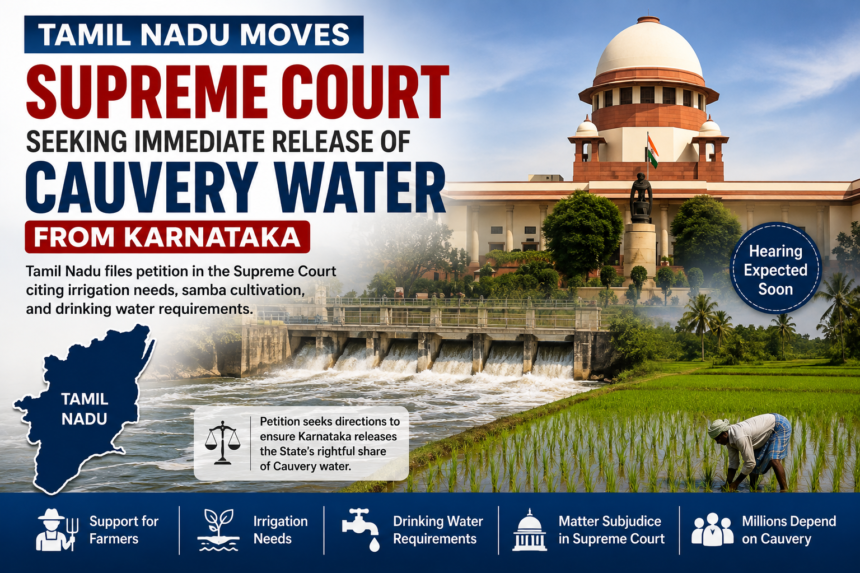
The Tamil Nadu Government has filed a petition before the Supreme Court of India, seeking directions to ensure the release of Cauvery water from Karnataka. The State has cited inadequate water inflows, the needs of farmers cultivating samba crops, and concerns over drinking water supply, requesting urgent intervention to secure its allocated share under the Cauvery water-sharing framework.
Tamil Nadu Approaches Supreme Court Over Cauvery Water Release
The long-standing Cauvery river water dispute has once again reached the Supreme Court, with the Tamil Nadu Government filing a fresh petition seeking the release of water from Karnataka.
According to the petition, Tamil Nadu has requested the apex court to direct Karnataka to release the water due under the existing Cauvery water-sharing arrangements. The State has argued that current inflows are insufficient to meet irrigation requirements, particularly for farmers preparing for the samba cultivation season, while also highlighting concerns over drinking water availability in several districts.
The move reflects Tamil Nadu’s continued reliance on judicial intervention whenever disputes arise over the implementation of Cauvery water-sharing directives.
Why the Cauvery River Is Crucial
The Cauvery River is one of South India’s most important river systems, supporting millions of people across Karnataka, Tamil Nadu, Kerala, and the Union Territory of Puducherry.
For Tamil Nadu, the river is essential because it provides:
- Irrigation for lakhs of acres of agricultural land.
- Water for paddy, sugarcane, and other crops.
- Drinking water to several towns and cities.
- Livelihoods for farming communities.
- Ecological support for river basin regions.
A delay or reduction in water release can significantly affect agriculture and water availability downstream.
Reason Behind the Fresh Petition
Tamil Nadu has informed the Supreme Court that the State is not receiving the quantity of Cauvery water it believes is due under the established sharing mechanism.
The petition reportedly highlights concerns such as:
- Lower-than-required water releases.
- Irrigation requirements for samba cultivation.
- Reservoir storage levels.
- Drinking water needs.
- Compliance with Cauvery water-sharing arrangements.
The State has sought urgent judicial intervention considering the importance of timely water availability during the cultivation season.
Importance for Farmers
The Cauvery basin supports thousands of farming families across the delta districts.
Adequate water availability is essential for:
- Timely sowing of samba paddy.
- Protecting standing crops.
- Maintaining agricultural productivity.
- Supporting rural livelihoods.
- Ensuring food production.
Farmer associations have consistently stressed that delayed water release can impact both crop yield and household income.
Read to know more about the Cauvery Water Management Authority (CWMA)
Legal Background
The Cauvery water dispute has been the subject of several legal proceedings over the years.
The issue has involved:
- Orders of the Supreme Court.
- Recommendations of the Cauvery Water Disputes Tribunal.
- Monitoring by the Cauvery Water Management Authority (CWMA).
- Periodic discussions between basin states regarding water availability.
Tamil Nadu’s latest petition seeks judicial directions to ensure implementation of the existing water-sharing framework in light of current requirements.
Possible Impact
If the Supreme Court considers the petition, the proceedings could influence:
- Water release schedules.
- Irrigation planning.
- Agricultural activities in Tamil Nadu.
- Reservoir management.
- Coordination between basin states.
- Decisions by the Cauvery Water Management Authority.
Officials from both states are expected to present their respective positions during the legal proceedings.
Read to know more about the India-WRIS (Water Resources Information System
The Importance of the Cauvery River for Tamil Nadu
The Cauvery River is one of South India’s most significant river systems, serving as a lifeline for agriculture, drinking water supply, and economic activity across Tamil Nadu. Originating in Karnataka and flowing through Tamil Nadu before reaching the Bay of Bengal, the river sustains millions of people and supports some of the country’s most fertile agricultural regions.
Districts such as Thanjavur, Tiruvarur, Nagapattinam, Mayiladuthurai, Tiruchirappalli, Karur, Erode, and parts of Salem depend heavily on Cauvery water for irrigation and livelihood.
The timely release of water plays a crucial role in ensuring agricultural productivity, food security, and rural employment.
Role of the Cauvery Water Management Authority (CWMA)
The Cauvery Water Management Authority (CWMA) was established to oversee the implementation of water-sharing arrangements among the basin states following legal and tribunal decisions.
The authority is responsible for:
- Monitoring reservoir storage levels.
- Assessing water availability.
- Regulating inter-state water releases.
- Ensuring compliance with the Cauvery water-sharing framework.
- Coordinating with Karnataka, Tamil Nadu, Kerala, and Puducherry.
Its role is critical in balancing the water requirements of all basin states while ensuring fair implementation of legal directives.
Read to know more about the Ministry of Jal Shakti
Impact on Agriculture
For Tamil Nadu’s farmers, especially those in the Cauvery delta, the release of water is closely linked to the success of the samba paddy cultivation season.
Adequate water availability helps in:
- Timely land preparation.
- Paddy transplantation.
- Sustaining standing crops.
- Improving crop yields.
- Protecting farmers’ livelihoods.
- Ensuring food grain production.
Delays in water release can disrupt the agricultural calendar and increase financial pressure on farming communities.
Follow for more interesting updates inside Coimbatore
Drinking Water and Public Needs
Beyond agriculture, the Cauvery River is also a major source of drinking water for several towns and cities in Tamil Nadu.
Water from the river supports:
- Urban drinking water schemes.
- Rural water supply projects.
- Industrial requirements.
- Livestock and allied agricultural activities.
Maintaining adequate river flow is therefore essential not only for farming but also for meeting the daily needs of millions of residents.
Balancing Water Sharing Among States
The Cauvery basin is shared by multiple states, making cooperation and effective water management essential.
Factors influencing water availability include:
- Southwest and northeast monsoon rainfall.
- Reservoir storage levels.
- Seasonal irrigation demand.
- Drinking water priorities.
- Climate variability.
Legal mechanisms and institutional coordination remain important for addressing disputes while ensuring equitable distribution.
What Happens Next?
Following Tamil Nadu’s petition, the Supreme Court is expected to consider submissions from all concerned parties before issuing any directions.
Possible developments include:
- Hearings before the Supreme Court.
- Responses from Karnataka.
- Reports from the Cauvery Water Management Authority.
- Further legal directions regarding water release.
- Monitoring of reservoir levels and compliance.
The outcome will be closely watched by farmers, policymakers, and residents across both states.
Key Highlights
- Tamil Nadu has sought Supreme Court intervention for the release of Cauvery water.
- The petition highlights irrigation and drinking water requirements.
- The Cauvery River supports agriculture, livelihoods, and water supply across several districts.
- The CWMA plays a central role in implementing the water-sharing framework.
- The Supreme Court’s decision could influence future water management during the current agricultural season.
Frequently Asked Questions (FAQs)
1. Why has Tamil Nadu approached the Supreme Court?
Tamil Nadu has sought directions for the release of Cauvery water, citing irrigation requirements, drinking water needs, and implementation of the existing water-sharing framework.
2. Why is the Cauvery River important?
The Cauvery River supports agriculture, drinking water supply, and livelihoods across Karnataka, Tamil Nadu, Kerala, and Puducherry, making it one of South India’s most important river systems.
3. What is the Cauvery Water Management Authority (CWMA)?
The CWMA is the statutory authority responsible for monitoring reservoir levels and implementing the Cauvery water-sharing arrangements among the basin states.
4. Which crops depend on Cauvery water in Tamil Nadu?
Cauvery water is especially important for samba paddy cultivation, along with sugarcane and several other agricultural crops in the delta region.
5. Has the Supreme Court issued a final order?
At the time of publication, the petition has been filed, and the matter is subject to judicial consideration. Any directions regarding water release will depend on the Court’s proceedings.
Conclusion
Tamil Nadu’s latest petition before the Supreme Court underscores the continuing importance of the Cauvery River for agriculture, drinking water, and the livelihoods of millions across the state. As farmers prepare for the samba cultivation season and water availability remains a key concern, the outcome of the legal proceedings could have a significant impact on irrigation planning and resource management.
The case also highlights the ongoing need for coordinated water governance, timely implementation of water-sharing arrangements, and cooperation among basin states to address both agricultural and public water requirements.
Today’s Coimbatore will continue to monitor the proceedings and provide timely updates on the Supreme Court case, Cauvery water management, agriculture, and major developments affecting Tamil Nadu.
Lorem ipsum dolor sit amet, consectetur adipiscing elit. Ut elit tellus, luctus nec ullamcorper mattis, pulvinar dapibus leo.