TL;DR
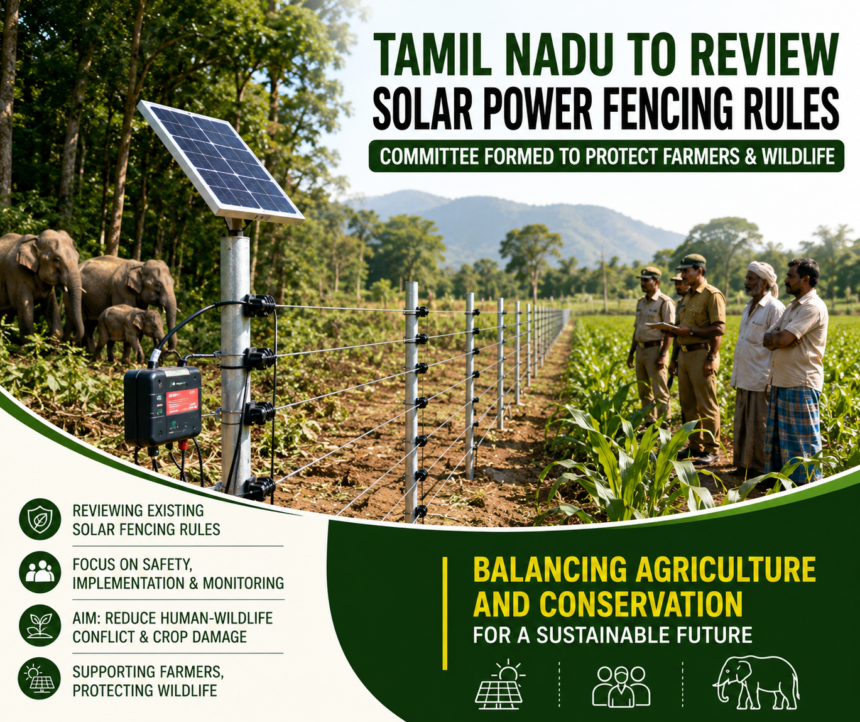
The Tamil Nadu Forest Department has constituted a committee to examine possible amendments to the Solar Power Fencing Rules. The review aims to improve the effectiveness and safety of solar-powered fencing used around agricultural lands while ensuring the protection of wildlife and reducing human-animal conflict in forest fringe areas.
Tamil Nadu Forest Department Begins Review of Solar Power Fencing Rules
The Tamil Nadu Forest Department has initiated a review of the existing Solar Power Fencing Rules by constituting a special committee to study possible amendments. The move comes amid growing discussions on balancing the needs of farmers with the protection of wildlife in areas bordering forests.
Solar-powered fencing has become a widely used method to protect crops from wild animals such as elephants, wild boars, and deer. However, officials believe that the existing framework can be strengthened to improve safety, ensure proper implementation, and minimise unintended impacts on wildlife.
The committee will examine current regulations, gather stakeholder feedback, and recommend changes that can support both agriculture and conservation.
Why Solar Power Fencing Is Important
Farmers living near forest boundaries often face significant crop losses due to wild animal intrusion. Solar-powered fencing provides a non-lethal deterrent by delivering a controlled, low-energy pulse that discourages animals from entering agricultural fields without causing permanent harm when installed and maintained according to approved standards.
Properly regulated solar fencing can help:
- Protect crops from wildlife damage.
- Reduce financial losses for farmers.
- Minimise direct encounters between humans and wild animals.
- Support peaceful coexistence in forest fringe villages.
- Promote safer farming practices.
Follow for more Wildlife Conservation Updates inside Coimbatore
Purpose of the Committee
According to the Forest Department, the committee will study the existing regulations and evaluate whether amendments are required to improve implementation.
The committee is expected to examine areas such as:
- Existing solar fencing guidelines.
- Safety standards and compliance.
- Installation procedures.
- Maintenance practices.
- Monitoring mechanisms.
- Wildlife protection measures.
- Farmer awareness and training.
- Suggestions from stakeholders and experts.
Its recommendations could help create a more effective framework for the future use of solar-powered fencing across Tamil Nadu.
Balancing Agriculture and Wildlife Conservation
Tamil Nadu has several agricultural regions located close to reserved forests and wildlife habitats. As human settlements expand and farming activities increase near these areas, incidents of human-wildlife conflict have also become more common.
Authorities aim to strike a balance by protecting farmers’ livelihoods while ensuring that conservation efforts are not compromised. Reviewing the solar fencing rules is seen as part of this broader approach to sustainable land management and wildlife protection.
Read to know more about the Ministry of Environment, Forest and Climate Change
Addressing Human-Wildlife Conflict in Tamil Nadu
Human-wildlife conflict has become a growing concern in several districts of Tamil Nadu, particularly in areas bordering forests where agriculture and wildlife habitats overlap. Farmers frequently face crop damage caused by animals such as elephants, wild boars, deer, monkeys, and other wild species.
Solar-powered fencing has emerged as one of the preferred preventive measures because it acts as a non-lethal barrier that helps discourage animals from entering farmlands while reducing the risk of direct confrontation between humans and wildlife.
The Forest Department’s review of the existing rules reflects an effort to improve both conservation practices and agricultural safety.
Why Updated Solar Fencing Guidelines Matter
As farming practices evolve and technology improves, regulations must also be updated to reflect current needs and best practices.
Revising the Solar Power Fencing Rules could help ensure:
- Uniform installation standards across the state.
- Improved safety for farmers and wildlife.
- Better monitoring and maintenance.
- Prevention of unauthorized or unsafe fencing systems.
- Greater accountability among installers and users.
- Increased awareness of legal compliance.
- Long-term sustainability of wildlife management efforts.
Clear guidelines can help reduce confusion while encouraging responsible use of solar fencing.
Supporting Farmers While Conserving Wildlife
Agriculture is the primary livelihood for thousands of families living near Tamil Nadu’s forest boundaries. Crop losses due to wildlife can have significant economic consequences, making preventive measures essential.
By reviewing the existing framework, the Forest Department aims to support farmers through regulated and scientifically designed fencing solutions while ensuring that wildlife continues to move safely within its natural habitat.
Balancing agricultural needs with environmental conservation remains one of the key objectives of sustainable development in the state.
Role of Scientific and Community Participation
Experts believe that successful wildlife management depends not only on technology but also on collaboration between government agencies, conservationists, scientists, and local communities.
Future recommendations may include:
- Training programmes for farmers.
- Regular inspection and maintenance of fencing systems.
- Community awareness campaigns.
- Technical guidance on approved solar fencing models.
- Improved coordination between Forest Department officials and local residents.
- Data-driven monitoring of human-wildlife conflict.
Such collaborative approaches can help reduce conflicts while promoting coexistence.
Read to know more about the best details on National Tiger Conservation Authority
Environmental Benefits of Proper Solar Fencing
When installed according to approved standards, solar-powered fencing offers several environmental advantages:
- Reduces crop damage without harming wildlife.
- Minimises direct encounters between humans and animals.
- Supports biodiversity conservation.
- Encourages non-lethal wildlife management.
- Promotes sustainable farming practices.
- Helps maintain ecological balance in forest fringe areas.
These benefits make regulated solar fencing an important tool for both conservation and rural development.
Frequently Asked Questions (FAQs)
1. Why is the Forest Department reviewing the Solar Power Fencing Rules?
The review aims to improve the effectiveness, safety, and implementation of solar-powered fencing while ensuring better protection for both farmers and wildlife.
2. What is solar power fencing?
Solar power fencing is a system that uses controlled electric pulses powered by solar energy to discourage wild animals from entering agricultural fields. When installed according to approved standards, it is intended to act as a deterrent rather than cause permanent harm.
3. Who will benefit from the proposed amendments?
The proposed changes are expected to benefit farmers, local communities, Forest Department officials, and wildlife by improving safety and promoting responsible fencing practices.
4. Will the committee immediately change the rules?
No. The committee has been formed to study the existing framework and provide recommendations. Any amendments will require review and approval by the appropriate authorities before implementation.
5. Why is regulated solar fencing important?
Proper regulation helps ensure safe installation, protects wildlife, reduces crop damage, and supports sustainable human-wildlife coexistence in agricultural areas near forests.
Follow for more Latest Environment News inside Coimbatore
Conclusion
The Tamil Nadu Forest Department’s decision to review the Solar Power Fencing Rules marks an important step towards addressing the challenges faced by farmers while strengthening wildlife conservation efforts. As human-wildlife interactions continue to increase in forest fringe regions, effective and well-regulated preventive measures are essential for protecting livelihoods and preserving biodiversity.
By evaluating existing regulations and incorporating expert recommendations, the proposed amendments have the potential to improve safety, promote responsible fencing practices, and encourage long-term coexistence between agriculture and wildlife.
Today’s Coimbatore will continue to follow this development and bring readers the latest updates on environmental policies, agriculture, wildlife conservation, and public initiatives across Tamil Nadu.
Lorem ipsum dolor sit amet, consectetur adipiscing elit. Ut elit tellus, luctus nec ullamcorper mattis, pulvinar dapibus leo.